The question David Eby was never able to answer
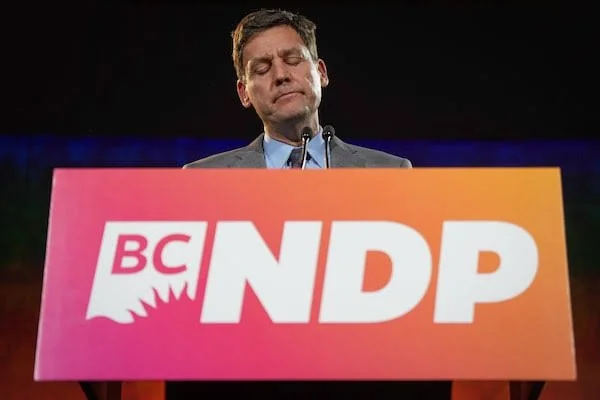
British Columbia Premier David Eby called a snap election to strengthen his government. Instead, he handed the opposition Conservatives a majority and ended his own reign in Canada’s third most populous province. To describe the events of the past six weeks in BC Politics as an “epic blunder” may do a disservice to the term. It is arguably the worst political miscalculation in Canadian politics since Ontario Premier David Peterson’s disastrous early election in 1990. Both illustrate the danger of asking voters for a new mandate without convincing them why one is needed.
Eby’s central failure was his inability to establish a compelling ballot-box question. The campaign kept returning to the question he had created: why are we having this election?
But first, for those who may be forgiven for not following BC’s political musical chairs, the gamble requires some context.
The Conservatives received less than two per cent of the vote in 2020. Their turnaround began when BC United, formerly the BC Liberals, suspended their 2024 campaign and backed them. Under John Rustad, the Conservatives won 44 seats, leaving Eby’s NDP with a narrow three seat majority. But by late August, the opposition was fracturing, generating a seemingly endless news cycle of dismay and discontent among its leaders and rank-and-file MLAs.
Thirteen legislators either left the Conservative caucus voluntarily or were expelled. Rustad’s successor, Former Federal Cabinet Minister Kerry-Lynne Findlay, had been seeking a seat in the provincial legislature through a by-election, all while fighting off attacks from within her own party.
The 32-day snap election
On September 20, facing mounting pressure, she resigned from the party leadership, a position she had held for less than four months. Lorne Doerkson became interim leader, and Eby called the election two days later, two years ahead of schedule. The opportunity appeared obvious: strike before the opposition could recover.
An opponent’s weakness may explain why a governing party wants an election, but it does little to explain why voters should want one.
Peterson learned that distinction in 1990. Three years into a substantial majority mandate, he called an early election and lost both government and his seat. He later acknowledged the damage caused by the early call and perceived arrogance. Eby’s defeat now offers another warning about confusing political opportunity with public permission.
His opening answer was Donald Trump. American economic pressure, he argued, required a renewed mandate. Yet he never convincingly connected that threat to the need for an immediate provincial election. By early October, Angus Reid found that only 10 per cent of British Columbians identified tariffs, Trump or the American alcohol ban among their most important voting issues. Cost of living stood at 57 per cent; health care at 42 per cent.
Eby then emphasized the frustrations of governing with a narrow majority. At the leaders’ debate, he asked for a stronger mandate to overcome legislative obstacles. That explained what the premier wanted more clearly than what voters would gain.
His policy arguments faced a similar credibility problem. Higher taxes on top earners would help finance health care, he promised. But discussion of future improvements also invited scrutiny of his government’s record and the province’s $13.8-billion deficit. Voters were being asked to renew their confidence before many felt the benefits of their previous endorsement.
Campaign missteps compounded that credibility problem.
Eby found himself defending his family’s access to $10-a-day childcare after his government froze the program’s expansion. He explained that their provider had joined the program and that the family had donated the savings back, but the controversy highlighted the gap between his government’s affordability promises and families still waiting for access.
Then there was the image of Eby promoting his “Built in BC and Canada” message while wearing Patagonia, a high-end American brand.
Both reinforced the opposition’s charge that his actions failed to match his rhetoric, leaving Eby to defend his credibility when he needed to earn voters’ confidence.
A final attempt to cling to power fell short, very short.
Warnings about the Conservatives became harder to sustain as Doerkson established himself. Eby’s late appeals to Green voters also failed to consolidate sufficient support. The opposition was changing while the premier remained trapped defending his decision to call the election.
The preliminary numbers reveal the consequences. Turnout was approximately 48.1 per cent, down from 58.45 per cent in 2024. Conservative votes fell from roughly 911,000 to 862,000. NDP votes dropped far more sharply, from approximately 945,000 to 671,000.
The Conservatives increased their vote share while receiving fewer votes.
The decisive collapse was on the NDP side. Totals cannot establish exactly which voters stayed home or switched parties, but they strongly suggest a failure to retain and mobilize NDP support. Disappointed supporters did not need to embrace the Conservatives to help them win.
BC now faces a transition under Doerkson, who must turn a recently fractured party into a functioning government. Cabinet appointments, fiscal choices and the sequencing of promises will matter immediately.
Following Eby’s announced resignation, the NDP must rebuild trust and choose a leader.
For political leaders, the cautionary tale will endure: explain what voters must decide, why it cannot wait and what they gain. Peterson’s defeat has warned premiers for decades. Eby’s may do so for generations.
A premier can choose the election date. Voters decide what the election is about.
You might also like